Pages

Showing posts with label Space. Show all posts

Saturday, February 25, 2012

Hubble telescope confirm the existence of a water planet.

The planet known as GJ 1214b, which was discovered in 2009, is 2.7 the Earth´s diameter, and its temperature is 230 ºC. 
It is made with a large proportion of water, and it is not as any other planet we actually know. To carry out the investigation, the exoplanet has been observed when it orbited in front of its star. The light of the star is filtered through the planetary atmosphere, which provides us information about the atmosphere composition.

An study of the density of this new planet has shown us that its density is lower than the Earth´s density, so it is possible that this planet has more water and less rocks than the Earth. Because of the hight temperature and its hight pressure, it can have estrange materials as hot ice.  

Here you can see some images of the GJ 1214b planet and the Hubble telescope.

GJ 1214b planet, discovered in 2009.


Hubble telescope

Saturday, February 4, 2012

Far side of the moon filmed by Nasa

This amazing video has been publish by Nasa this week:


This images shows the dark side of the moon, an area of the moon that due to the rotational movement of the moon and the Earth couldn´t be observed.

But one of the twin GRAIL spacecraft launched by Nasa last September has returned its first video of the Moon's hidden side.

This video and all the data collected had been use to reconstruct a topographic map of the dark and unknown area wich is the dark side as haven´t done before.

The images show a more leaky than the visible part because it recives more impacts. In adition, we could observe the Drygalski crater, wich have acurious star form inside. This crater can be seen in the second 29 of the video in the bottom right side.

At end, an amzing image from dark side:


VIa: NASA

Artículo en Español

Monday, December 26, 2011

Expedition 30 Soyuz Docking at ISS

The Russian Soyuz TMA-03M spacecraft successfully docked to the ISS at the Mini Research Module-1 (MRM-1) “Rassvet” Nadir docking port at 3:19 PM GMT on 23, Friday.

The Soyuz TMA-03M was launched from the Baikonur Cosmodrome on 21, Wednesday.

Friday, December 23, 2011

Other Moons might exist


A result that won't disappoint you was released on Tuesday. According to scientists, at any given time, there should be at least one natural Earth satellite of one-meter diameter orbiting the Earth.

A mysterious body orbiting the Earth was first discovered in 2006 by some scientists from the University of Hawaii, but it actually turned to be a tiny asteroid. Furthermore, it was something similar to our Moon. It orbited us till June 2007, when it left on the lookout for new planets to orbit. This object, later named 2006 RH120 was the first documented example of a temporary Moon.

Later on, serious studies were launched to discern whether there are actually several Moons around us. The latest information obtained from these investigations is the one above mentioned. In other words, our planet might have a secret moon orbiting us. Such objects typically stay for about 10 months, making three revolutions around the planet.

NASA has repeatedly focused on their interest of sending people to asteroids, so if we could find and orbiting asteroid, it would be great. The trouble is that these asteroids are too tiny to be clearly seen and located. Despite this, we should still try it, paraphrasing Mikael Granvik, researcher at the University of Hawaii: "The scientific potential of being able to first remotely characterize a meteoroid and then visit and bring it back to Earth would be unprecedented."

Further information can be found at MIT Technology Review web.

Via: Fox News

Wednesday, December 21, 2011

Mars Missions Create Tough Armor

When the Mars Pathfinder (1997) and Mars Rover (2004) missions landed on the Red Planet, they landed hard. These were unmanned missions, of course, with some guidance from engineers on Earth -- but not as much as they'd like. The equipment was designed to crash land, gently, with a cage of airbags to cushion the fall from space.

Obviously, not just any airbag would work. NASA required the material to be lightweight and able to withstand extreme temperatures for the interplanetary flight. The material also had to be tough enough to keep the airbags inflated as the whole apparatus bounced along the rocky, sharp surface of Mars.
NASA's Jet Propulsion Laboratory worked with Warwick Mills, the company that had woven the reentry parachutes for the Apollo missions in the 1960s, to create a layered, coated, liquid-crystal polyester fiber that would fit the bill.

Warwick took the technology and ran with it, creating TurtleSkin protective gear that can withstand punctures from needles, knives and even bullets. The flexibility of the tightly woven fabric, which helped keep the Mars landers safe, now also keeps military and police officers safe.

For more invormation of Nasa inventions, click here. or here.
Read this article in spanish click here.

Tuesday, December 20, 2011

The new telescopes generation

In the next few days, a spanish institute, the Canarian Institute of Astrophisics (ICA) will start the installation of the fastest ultrasensible camera of the world. The camera is up to three times faster than its predecessors reaching the speed of 1500 images per second, and it's resolution has been multiplied by four, compared with the previous generation of ultra sensible cameras.
The main limitation of the telescopes which are set on earth's surface is the light distorsion caused by the atmosphere, which is why current telescopes cant recieve neat images.
This problem was solved a couple of years ago with the Hubble telescope by launching it in a satellite, avoiding the problem of the light distorsion. However, this solition has some drawbacks, such as the difficult access if a repair is needed.
The combination of the new camera system and the incredibly good location of the ICA, will allow the telescope to have an easy access, as well as recieving good resolution images.
Unfortunately, the installation of the new camera is starting now, which means that the whole system won't be fully operational until the summer of 2013, at least.

Sunday, December 18, 2011

Paul Allen announces revolution in Space Transportation

Microsoft co-founder Paul G. Allen announced some days ago one (more) of the most recognized collaborations: he will be joining efforts with Burt Rutan, the well-known aerospacial pioneer, to make the biggest plane ever built as an approach to commercial space transport.


It is not the first time they collaborate. In 2004, they launched the SpaceShipOne, the first manned spacial vehicle privately financed. Furthermore, they have other projects as the SpaceShipTwo, SpaceShipThree...

SpaceShipOne

Stratolaunch Systems is the name of the company which is developing the aircraft. Allen illustrates us explaining the main components of the project:
  • A carrier aircraft, developed by Scaled Composites, by Rutan.
  • A multi-stage booster, manufactured by Elon Musk's Space Exploration Technologies.
  • An integration system allowing the carrier to carry up to 200 tons in flight.
This flying titan is supposed to start testing phase on 2016. Some of the aircraft's numbers are absolutely amazing. The Space Ship is as big as a soccer stadium; it will be powered by six Boeing 747 motors; it will have a gross weight of more than 550 tons; for takeoff and landing, it will need a runway of more than 3.5 kilometers...

Here you have an explanatory video about Paul G. Allen's project:


As Allen says:
I want to break the "it's impossible" limit.

Via OnOrbit alpha
Via New York Times

Friday, December 16, 2011

Taking satellites to the operating theatre


We all know how hard it is the existing problem of a satellite stopping working to solve, as there's nearly no way of fixing it, especially now that the space shuttle has been retired. But some engineers at Johns Hopkins University have had a bright idea and they have it successfully applied using a remotely controlled robot as part of a NASA research grant program.

This happened two weeks ago and was carried out by students Tian Xia and Jonathan Bohren by using a modified Da Vinci medical use intended robot to manipulate another robot.

“The long-range goal is to be able to manipulate a space robot like this from any location to refuel satellites, for instance,” Bohren said. “A lot of satellites have the potential to have their lives extended if we can do that.”

Though this is a wonderful opportunity to save millions of dollars as we'll be able to repair the satellites instead of sending new ones and to reduce the space junk, there are still some constraints to be solved; for instance, how to take this complex robot to where the satellite is and arrive to where the breakdown is.

Further information can be found here.

Monday, December 12, 2011

New ISS crew


This video shows, what it is going to be, the next ISS crew from Russia.


This video has been taken out from Youtube, and out of the twitter account of @Nasa.

In Spanish this entrie can be found here.

Saturday, December 10, 2011

Lunar eclipse

Today, a great number of people had seen how the last lunar eclipse from the year transforms the moon in a huge red ball as seen in the image:


This eclipse, the last of the year, could only be observed from Australia, Asia and north-east Ameica.

Luckly, lots of web pages such as AstronomyLive had retransmitted it so people from all the world could saw it.

I expected alll of you had been delighted with this magnific astronomicall event wich would not be repited until 2014.

Via: ABC

Artículo en Español

Friday, December 9, 2011

The new Earth watcher

The Sentinel-2A is the first of two Sentinel-2 satellites. Stentinel-2 have been designed to deliver continuously updated high-resolution data for the provision of initial G.M.E.S. (Global Monitoring for Environment and security) operational services for agricultural, forest management , civil protection and humanitarian relief applications. Sentinel-2 will also be used to monitor natural disasters such as flooding, volcanic eruptions, subsidence and landslides.


Once in orbit, in 2013, Sentinel-2A will support land monitoring services throughout its desing live of at least seven years. Sentinel-2A will later be joined by Sentinel-2B in 2015. This duo will hakve the time required to complete a full global monitoring cycle, enabling seasonal and year-to-year changes to be mapped which unprecedented acuracy.


The fiers one, Sentinel-2A, is being assembled in the Astrium installations in Madrid, Spain. The pre-integrated platform for the Sentinel-2A satellite is the beginning of a new space proyect for the Spanish space engineering. This satellite platform, constructed by the Astrium engineers is equiped with its propulsion system, heat shield and complete wiring harness. The integration and test team, led by Thilo Nacke, will now spend the next two years completing the final stages of tje satellite's construction in the cleanroom as well as installing and testing the measuring instruments required for its mission under the supervision or the European Space Agency.

Tuesday, December 6, 2011

Kepler satellite discoveries


Kepler has confirmed the existence of a planet which is in a habitable zone, the Kepler-22b. This is the first planet of the 54 candidates reported in february 2011 which has been already confirmed. It is the smallest planet found in an habitable zone, as it is about 2.4 times the radius of Earth.

It is located 600 is located 600 light years away from Earth. Even though the Kepler-22b is larger than Earth, it's 290-day orbit around a sun-like star is like our planet's orbit.

The scientists of the NASA don't know yet whether the Kepler-22b is solid, liquid or gaseous."This is a major milestone on the road to finding Earth's twin," said Douglas Hudgins, Kepler program scientist at NASA Headquarters in Washington.

Kepler mesures gaps in the brightness of stars, in order to detect planet, or at least, planet candidates. It needs at least three "transits" (loops around it's star) to consider the existence of a planet.

Wednesday, November 30, 2011

Tuesday, November 29, 2011

Fire in space


Having no gravity force in the space makes the fire behave in a very strange way, which is dangerous and unpredictable..
In order to study better these behaviors and the way to prevent or put out a fire in the international space station (ISS), the NASA celebrates today the two years in which it has done about 200 experiments, all of them included in the FLEX (flames extinction) experiments program.
The American agency assures that knowing how to put out a fire in the space is of vital importance, especially if you have to live in small spaces, like the spacemen who live at the ISS.
“We hope to obtain grater knowledge about burning processes, improve the security against fire in our spaceships, and to get ideas for a more efficient utilization of liquid fuels in earth”, said Forman Williams, head researcher in the FLEX project.

Saturday, November 26, 2011

A new solar system

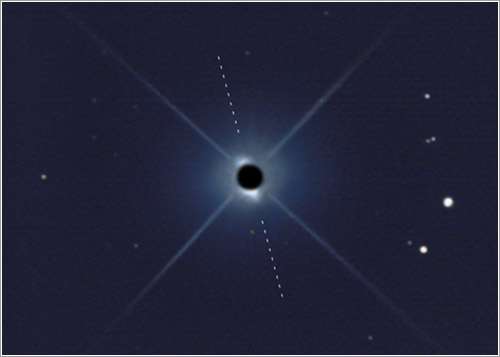
Beta Pictoris, is the second most brilliant from the constallation of Pictor, it is arround 63,4 light years from Earth, since 1984 scientist have known that around Beta Pictoris is an protoplanetary disk in wich planets are being forming up.
The awesomness of the notice, is that th photos al the end where taken by an amateur astronomer from Australia; since now, the images have being taken from instruments such as Hubble, the Spitzer, or the VLT from ESO.
This are the photos


Related Posts Plugin for WordPress, Blogger...