This amazing video has been publish by Nasa this week:
This images shows the dark side of the moon, an area of the moon that due to the rotational movement of the moon and the Earth couldn´t be observed.
But one of the twin GRAIL spacecraft launched by Nasa last September has returned its first video of the Moon's hidden side.
This video and all the data collected had been use to reconstruct a topographic map of the dark and unknown area wich is the dark side as haven´t done before.
The images show a more leaky than the visible part because it recives more impacts. In adition, we could observe the Drygalski crater, wich have acurious star form inside. This crater can be seen in the second 29 of the video in the bottom right side.
At end, an amzing image from dark side:
VIa: NASA
Artículo en Español
Showing posts with label Science. Show all posts
Saturday, February 4, 2012
Saturday, December 24, 2011
Merry Christmas from the DeLaCosa CanSat Team
In the name of the DeLaCosa CanSat Team I want to wish you merry Christmas!!
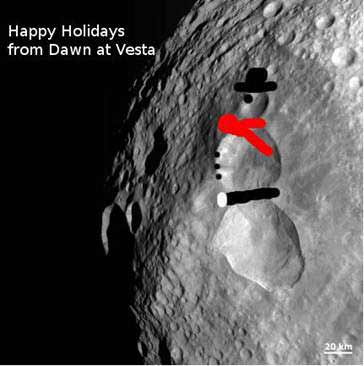
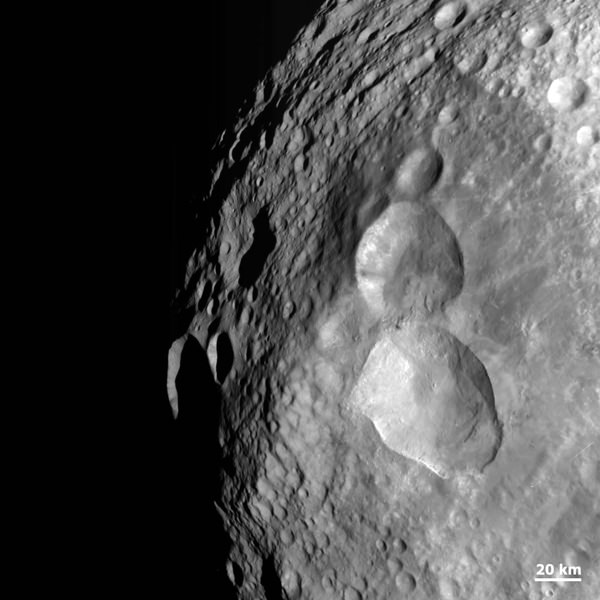
As it could not be otherwise, I will show you some pictures of the outer space, which seem to be taken specially for this dates:

As you see above, some craters in the Vesta asteroid were formed to look like a snowman!!
Definitely, Nature is wiser than we usually think.
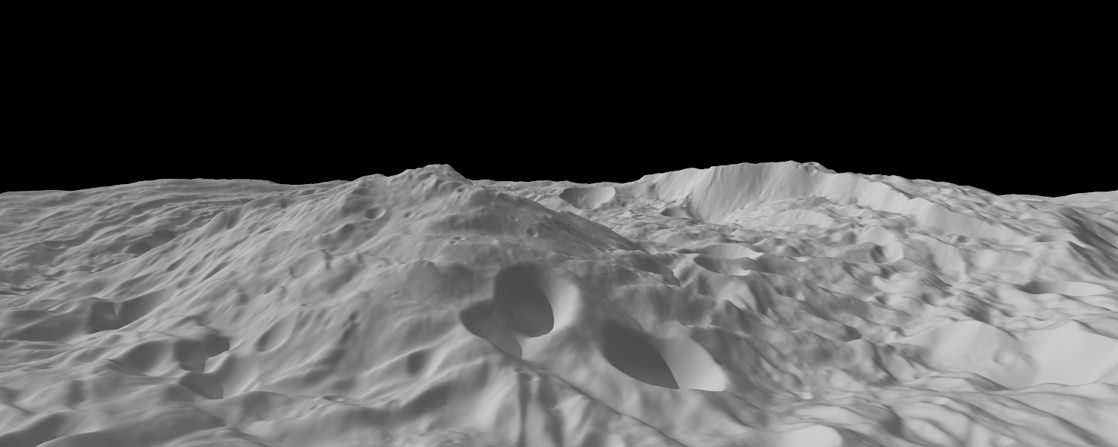
By the way, check out this awesome shape model of the highest mount on the asteroid.We hope to be succesful on our mission and eventually finish with something similar!
As it could not be otherwise, I will show you some pictures of the outer space, which seem to be taken specially for this dates:
As you see above, some craters in the Vesta asteroid were formed to look like a snowman!!
Definitely, Nature is wiser than we usually think.
By the way, check out this awesome shape model of the highest mount on the asteroid.We hope to be succesful on our mission and eventually finish with something similar!
Friday, December 23, 2011
Other Moons might exist
A mysterious body orbiting the Earth was first discovered in 2006 by some scientists from the University of Hawaii, but it actually turned to be a tiny asteroid. Furthermore, it was something similar to our Moon. It orbited us till June 2007, when it left on the lookout for new planets to orbit. This object, later named 2006 RH120 was the first documented example of a temporary Moon.
Later on, serious studies were launched to discern whether there are actually several Moons around us. The latest information obtained from these investigations is the one above mentioned. In other words, our planet might have a secret moon orbiting us. Such objects typically stay for about 10 months, making three revolutions around the planet.
NASA has repeatedly focused on their interest of sending people to asteroids, so if we could find and orbiting asteroid, it would be great. The trouble is that these asteroids are too tiny to be clearly seen and located. Despite this, we should still try it, paraphrasing Mikael Granvik, researcher at the University of Hawaii: "The scientific potential of being able to first remotely characterize a meteoroid and then visit and bring it back to Earth would be unprecedented."
Further information can be found at MIT Technology Review web.
Via: Fox News
Monday, December 19, 2011
100 years since the first men in the South Pole
Amundsen secretly began planning to travel to the South Pole instead. In October, he sent a telegram notifying British explorer Robert Falcon Scott, who was a preparing a South Pole exploration, of his intentions. The telegram said: “Beg leave inform you proceeding Antarctic. Amundsen,”. Amundsen would later be critized because of his silence, critics at the ones he would respond: "I knew I should be able to inform Captain Scott...''
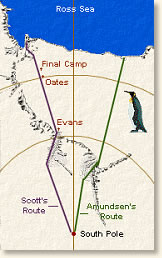
It was then when the race to the South Pole began. Each ''team'' arrived in Antarctica in January 1911; Scott established base camp at McMurdo Sound, while Amundsen set up his camp, called Framheim, at the Bay of Whales on the Ross Ice Shelf, located 60 miles closer to the pole.
The two parties prepared for the journey to the pole by making expeditions south and establishing supply depots along their intended paths. The Amundsen party, which relied on sled dogs and skies, reached farther south than the Scott party, whose Siberian ponies, sled dogs and technical equippement, were less efficiant for the conditions.
Amundsen set off for the pole with seven men in September (the start of the Antarctic spring). But just aphew days into their trip, the weather turned cold and many of the members of the party suffered frosbite, so they retreated back to Framheim. Hjalmer Johansen criticized Amundsen’s leadership and was expelled from the traveling party; the humiliated Johansen would later commit suicide upon his return to Norway.
Amundsen began his second push for the pole on Oct. 20 of the same year, accompanied by four men (Olav Bjaaland, Helmer Hanssen, Sverre Hansel y Oscar Wisting) and more than 50 dogs. Scott and his 13 men set off from their camp on Nov. 1 with dogs, ponies and motor sledges.
Traveling much lighter, the Amundsen team had few difficulties. On the afternoon of Dec. 14, the five explorers—Amundsen, Helmer Hanssen, Olav Bjaaland, Sverre Hassel and Oscar Wisting—became the first men to ever reach the South Pole.
Amundsen later wrote: “After we had halted we collected and congratulated each other. (…) After this we proceeded to the greatest and most solemn act of the whole journey—the planting of our flag. (…) I had determined that the act of planting it—the historic event—should be equally divided among us all. It was not for one man to do this; it was for all who had staked their lives in the struggle, and held together through thick and thin.”
Bjaaland took pictures of his four fellow explorers as they posed near the flag. Before the group left the pole on Dec. 16, Amundsen left Scott supplies and a note asking him to tell Norwegian King Haakon VII of his accomplishment. The group arrived safely back at Framheim on Jan. 25, 99 days and 1,860 miles after their departure. Despite this, amundsens journey was not a wonderfull one either, his party had to sacrifice about 24 dogs in orther to get supplies.
Scott, meanwhile, did not reach the South Pole until Jan. 17, 33 days after Amundsen. He and the four other men chosen to make the final push— Edward Wilson, Henry Bowers, Lawrence Oates and Edgar Evans—were suffering from malnourishment, frostbite, hypothermia and likely scurvy. They were disheartened to find the Norwegian flag waiting for them.
Scott wrote in his diary, “The Pole. Yes, but under very different circumstances from those expected. We have had a horrible day—add to our disappointment a head wind 4 to 5, with a temperature -22 degrees, and companions labouring on with cold feet and hands. … Great God! This is an awful place and terrible enough for us to have laboured to it without the reward of priority.”
On the return trip, Evans fell in a crevasse and suffered a head injury, contributing to his death 15 days later. Captain Oates decided to end his life; as he walked out of his tent to certain death, he told his comrades, “I am just going outside and may be some time.” The remaining three men died only a few days later. All this is pretty well explained in one of the links above.
From that moment, about 40 missions to the Pole have been made. And between them I have to emphasize the ones made by Mikel Zabalza and Ignacio Oficialdegui, both Spanish from Navarra.
More information here, here, HERE or either here.
The publication in Spanish may be found here
Sunday, December 18, 2011
Paul Allen announces revolution in Space Transportation
Microsoft co-founder Paul G. Allen announced some days ago one (more) of the most recognized collaborations: he will be joining efforts with Burt Rutan, the well-known aerospacial pioneer, to make the biggest plane ever built as an approach to commercial space transport.
It is not the first time they collaborate. In 2004, they launched the SpaceShipOne, the first manned spacial vehicle privately financed. Furthermore, they have other projects as the SpaceShipTwo, SpaceShipThree...
| SpaceShipOne |
Stratolaunch Systems is the name of the company which is developing the aircraft. Allen illustrates us explaining the main components of the project:
- A carrier aircraft, developed by Scaled Composites, by Rutan.
- A multi-stage booster, manufactured by Elon Musk's Space Exploration Technologies.
- An integration system allowing the carrier to carry up to 200 tons in flight.
This flying titan is supposed to start testing phase on 2016. Some of the aircraft's numbers are absolutely amazing. The Space Ship is as big as a soccer stadium; it will be powered by six Boeing 747 motors; it will have a gross weight of more than 550 tons; for takeoff and landing, it will need a runway of more than 3.5 kilometers...
Here you have an explanatory video about Paul G. Allen's project:
I want to break the "it's impossible" limit.
Via OnOrbit alpha
Via New York Times
Friday, December 16, 2011
Taking satellites to the operating theatre
We all know how hard it is the existing problem of a satellite stopping working to solve, as there's nearly no way of fixing it, especially now that the space shuttle has been retired. But some engineers at Johns Hopkins University have had a bright idea and they have it successfully applied using a remotely controlled robot as part of a NASA research grant program.
This happened two weeks ago and was carried out by students Tian Xia and Jonathan Bohren by using a modified Da Vinci medical use intended robot to manipulate another robot.
Though this is a wonderful opportunity to save millions of dollars as we'll be able to repair the satellites instead of sending new ones and to reduce the space junk, there are still some constraints to be solved; for instance, how to take this complex robot to where the satellite is and arrive to where the breakdown is.
Further information can be found here.
Sunday, December 11, 2011
Space colonization with microscopic worms
The all-known Stephen Hawking believes Humanity's future does not rely on the place where we live. The Earth is a rich place, however it is limited in its resources. Therefore, Hawkins makes a call to ambitious scientists: start thinking of making human species able of leaving the Earth.
The main limitation about this change is the human body: are we up to this? Scientists at The University of Nottingham are carrying out an investigation on the Caernohabditis elegans, a microscopic worm which seems to be very similar to our own organism. Evidences tend to bear out the fact that the main life of this microscopic worm still carries out the same in space as if it was on Earth.
This approach to understand how human organism may behave on space might bring enthusiasts to learn more about this almost science-fiction fact, and who knows, maybe open new ways of space colonization.
Artículo en español
Article en français
Subscribe to:
Posts (Atom)